4.5.1 Any subset in a discrete space has no limit points. For any x, take U = {x} in the definition.
4.5.2 Let A be a subset in a trivial topologiocal space X. The U = X in the definition of limit points. This leads to three cases:
- A = ∅. Then A has no limit points.
- A = {a}. Then any point except a is a limit point.
- A has at least two points. Then any point is a limit point.
4.5.3 Let A be a subset in a space with finite complement topology. We have two cases:
- A is finite. Then for any x ∈ X, U = X - (A - x) is an open subset such that x ∈ U and (A - x) ∩ U = ∅. Therefore A has no limit points.
- A is infinite. Then for any x ∈ X and finite subset F ⊂ X, we have (A - x) ∩ (X - F) = A - (x ∪ F) ≠ ∅. Therefore any point is a limit point of A.
4.5.4 Suppose an ∈ A is a strictly decreasing sequence with x as the limit. Then for any ε > 0, there is N such that x ≤ an < x + ε for n ≥ N. Then by x ≤ aN+1 < aN, we have aN ∈ (A - x) ∩ [x, x + ε). In particular, (A - x) ∩ [x, x + ε) ≠ ∅, and this implies that x is a limit point of A in the lower limit topology.
Conversely, let x be a limit point of A in the lower limit topology. Then the following process produces a strictly decreasing sequence an ∈ A convergent to x.
a1 ∈ (A - x) ∩ [x, x + 1) = A ∩ (x, x + 1),
a2 ∈ A ∩ (x, min{a1, x + 1/2}),
a3 ∈ A ∩ (x, min{a2, x + 1/3}),
…
an ∈ A ∩ (x, min{an-1, x + 1/n}),
…
4.5.5 Suppose supA = +∞. Then for any x ∈ U = (b, ∞), we can always find big a ∈ A, such that a > x. Then a ∈ (A - x) ∩ U.
Suppose l = supA < +∞, and (l - ε, l) ∩ A ≠ ∅. The following shows that A' = (-∞, l].
Suppose x < l. Then (x, l) ∩ A ≠ ∅, so that x ∈ U = (b, ∞) implies (A - x) ∩ U ⊃ (A - x) ∩ (x, ∞) ⊃ A ∩ (x, l) ≠ ∅. This proves that x ∈ A'.
Suppose x = l. Then x ∈ U = (b, ∞) implies b < l, so that (b, l) ∩ A ≠ ∅. This further implies (A - x) ∩ U ⊃ (A - x) ∩ (b, l) = A ∩ (b, l) ≠ ∅. This proves that x ∈ A'.
Suppose x > l. Then x ∈ U = (l, ∞), but (A - x) ∩ U ⊂ A ∩ (l, ∞) = ∅. This proves that x ∉ A'.
Suppose l = supA < +∞, and (l - ε, l) ∩ A = ∅ for some ε > 0. Then the discussion above for the cases x < l and x < l still hold. For the case x = l, we have x ∈ U = (l - ε, ∞) and (A - x) ∩ U = ∅.
4.5.6 We consider a topology T and the topology TA = {U ∪ B: U ∈ T, B ⊂ A} in Exercise 4.4.6. For any subset Z, we denote by Z' and Z'A the limits points with respect to T and TA. A point x ∈ Z'A if and only if the definition for limit points apply to both U and B. Specifically, this means the following two are satsified:
x ∈ U ∈ T ⇒ (Z - x) ∩ U ≠ ∅: This means exactly x ∈ Z'.
x ∈ B ⊂ A ⇒ (Z - x) ∩ B ≠ ∅: The assumption never happens when x ∉ A. In case x ∈ A, we may take B = {x} and get (Z - x) ∩ B = ∅, so that x ∉ Z'A.
We conclude that Z'A = Z' - A.
4.5.8 1. {n}' = {p1k1…pnkn: ki > 0}, where p1, …, pn are all the prime factors of n.
(nN)' = N.
(N - 2N)' = N - 2N.
2. {n}' = all factors of n except n itself.
(nN)' = N.
(N - 2N)' = N - 2N.
3. {n}' = N - 2k+1N - {n}, where 2k is the 2-factor of n.
(nN)' = N.
(N - 2N)' = N - 2N.
4.5.9
| limits of [0, 1] | limits of (0, 1) | limits of (√2, √10) | limits of Z | limits of (-∞, 0) | |
| 1 | (-1, 2) | [0, 1] | (1, 4) | R | (-∞, 0] |
| 2 | [0, 1) ∪ [1, 2) | [0, 1) | [√2, 4) | R - Z | (-∞, 0) |
| 3 | [0, 1) | [0, 1) | [1, √10) | ∅ | (-∞, 0) |
| 4 | [-1, 1] | [-1, 1] | [-√10, √10] | R | R |
| 5 | R | R | (-∞, -1/√2] ∪ [√2, ∞) | R - 0 | R |
| 6 | (-∞, a] | (-∞, a] | (-∞, b] | R | (-∞, c] |
a = first an satisfying an ≥ 1. b = first an satisfying an ≥ √10. c = first an satisfying an ≥ 0.
4.5.12 A limit point remains a limit point in the coarser topology. One may simply follow the definition and notice that the open subset used for the definition of limit points in the coarser topology is also open in the finer topology.
The other way around is not true. Suppose a subset has limit points in some topology. If the topology is refined to become the discrete topology, then all limit points are lost: There are no limit points in the discrete topology.
4.5.13 1. By the proof in Exercise 2.5.4 with 3) d(a, x) < ε replaced by 3) x ∈ U.
2. The proof is actually simpler than before. First by the first part we conclude that A' ∪ B' ⊂ (A ∪ B)'. To show the inclusion in another direction, we consider a point x ∉ A' ∪ B' and wish to prove it is not a limit point of A ∪ B.
By x ∉ A', we have an open subset U containing x, such that (A - x) ∩ U = ∅. By x ∉ B', we have an open subset V containing x, such that (B - x) ∩ V = ∅. Then U ∩ V is an open subset containing x, satisfying
(A ∪ B - x) ∩ (U ∩ V) ⊂ ( (A - x) ∩ U ) ∪ ( (B - x) ∩ V ) = ∅.
Thus x is not a limit point of A ∪ B.
3. Follows from the first part.
4.5.14 For fixed x,
x is a limit point of A
⇔ for any x ∈ U, U open, we have (A - x) ∩ U ≠ ∅
⇔ for any x ∈ U, U open, we have ((A - x) - x) ∩ U ≠ ∅ (because (A - x) - x = A - x)
⇔ x is a limit point of A - x.
4.5.15 The statement A' ∩ U ⊂ (A ∩ U)' still holds. Assume x ∈ A' ∩ U. Let x ∈ V and V be open. Then x ∈ U ∩ V and U ∩ V is also open. By the definition of limit points, the intersection (A - x) ∩ (U ∩ V) ≠ ∅. However, the intersection is also ((A ∩ U) - x) ∩ V. This proves the implication
x ∈ V and V is open ⇒ ((A ∩ U) - x) ∩ V is nonempty ≠ ∅.
In other words, x is a limit point of A ∩ U.
The claim about infinitely many point in A ∩ U is no longer true. A counterexample is given by a subset of at least two points as A, in a finite topological space X with trivial topology, and with U = X (see Exercise 4.5.2).
4.5.17 [a, b] is closed with respect to B1, B2, B3, B7, B8, B10 but not the others.
4.5.18 1. closed complement of {f: f(0) < 1}, which is open.
2. closed If g is in the limit, then for any ε > 0, we have f ∈ B(g(0), g(1), 0, 1, ε) satisfying f(0) ≥ f(1). This implies g(0) + ε > f(0) ≥ f(1) > g(1) - ε. Since this holds for any ε, we get g(0) > g(1).
3. closed. complement of {f: f(0) < 1} ∪ {f: f(0) > 1}, which is open.
4. not closed the constant 0 funciton is a limit.
5. not closed any function is a limit.
6. not closed any function is a limit.
4.5.19 The condition is the same as {1, 2}, {3, 4}, {1, 4} should be open. In the coarsest such topology, the open subsets are ∅, {1}, {4}, {1, 2}, {1, 4}, {3, 4}, {1, 2, 3}, {1, 3, 4}, {1, 2, 3, 4}.
4.5.20 Since C is closed, X - C is open. Thus U - C = U ∩ (X - C) is, as intersection of two open subsets, open. The similar argument shows C - U is closed.
4.5.22 1. Let x be a limit point of A'. Then for any open U containing x, (A' - x) ∩ U ≠ ∅. Let a' ∈ (A' - x) ∩ U. Then U - x is an open (because {x} is closed) subset containing a'. Since a' ∈ A', we see that (A - a') ∩ (U - x) ≠ ∅. This implies (A - x) ∩ U ≠ ∅. Thus x is a limit point of A.
2. Consider X = {1, 2} with the trivial topology. For A = {1}, we have A' = {2}, A'' = {1}.
4.6.1 We may use A = A ∪ A' to find the closure.
Exercise 4.5.5: A = (-∞, supA].
Exercise 4.5.6: ZA = Z ∪ (Z - A) = Z - (A - Z).
Exercise 4.5.8(1): = {p1k1…pnkn: ki > 0}, where p1, …, pn are all the prime factors of n; = N; = N - 2N.
Exercise 4.5.8(2): = all factors of n including n itself; = N; = N - 2N.
Exercise 4.5.8(3): = N - 2k+1N, where 2k is the 2-factor of n; = N; = N - 2N.
Exercise 4.5.9:
| closure of [0, 1] | closure of (0, 1) | closure (√2, √10) | closure of Z | closure of (-∞, 0) | |
| 1 | (-1, 2) | [0, 1] | (1, 4) | R | (-∞, 0] |
| 2 | [0, 1]∪ [1, 2) | [0, 1) | [√2, 4) | R | (-∞, 0) |
| 3 | [0, 1] | [0, 1) | [1, √10] | Z | (-∞, 0) |
| 4 | [-1, 1] | [-1, 1] | [-√10, √10] | R | R |
| 5 | R | R | (-∞, -1/√2] ∪ [√2, ∞) | R | R |
| 6 | (-∞, a] | (-∞, a] | (-∞, b] | R | (-∞, c] |
a = first an satisfying an ≥ 1. b = first an satisfying an ≥ √10. c = first an satisfying an ≥ 0.
4.6.2 Let I = {(0, y): -1 ≤ y ≤ 1} be the part of the y-axis satisfying -1 ≤ y ≤ 1. Then = Σ ∪ I.
4.6.3 1. k is in the closure of A if and only if |k| ≤ n implies A ∩ [-n, n] ≠ ∅. Therefore A = [-a, a], where a is the maximum of the absolute values of the numbers in A.
2. k is in the closure of A if and only if 2m ≤ k ≤ 3n implies A ∩ [2m, 3n] ≠ ∅. We need to consider smallest [2m, 3n] that contains k. Therefore we consider k modulo 6. Denote Ai = A ∩ (6N + i).
k = 6l ∈ 6N: We have k ∈ [k, k] = [2(3l), 3(2l)]. Therefore k is in the closure if and only if k ∈ A. Such limit points form A0.
k = 6l + 1 ∈ 6N + 1: We have k ∈ [k - 1, k + 2] = [2(3l), 3(2l + 1)]. Therefore k is in the closure if and only if A ∩ [k - 1, k + 2] ≠ ∅. The non-empty condition means that k ∈ A + 1, or k ∈ A, or k ∈ A - 1, or k ∈ A - 2. Thus we get the limit points to be the union of the following four subsets: (A + 1) ∩ (6N + 1) = A0 + 1, A ∩ (6N + 1) = A1, (A - 1) ∩ (6N + 1) = A2 - 1, (A - 2) ∩ (6N + 1) = A3 - 2.
k = 6l + 2 ∈ 6N + 2: We have k ∈ [k, k + 1] = [2(3l + 1) , 3(2l + 1)]. Therefore k is in the closure if and only if A ∩ [k, k + 1] ≠ ∅. Similar argument shows the limit points to be the union of the following two subsets: A ∩ (6N + 2) = A2, (A - 1) ∩ (6N + 2) = A3 - 1.
k = 6l + 3 ∈ 6N + 3: We have k ∈ [k - 1, k] = [2(3l + 1) , 3(2l + 1)]. Therefore k is in the closure if and only if A ∩ [k - 1, k] ≠ ∅. We get the union of the following two subsets: (A + 1) ∩ (6N + 3) = A2 + 1, A ∩ (6N + 3) = A3.
k = 6l + 4 ∈ 6N + 4: We have k ∈ [k, k + 2] = [2(3l + 2) , 3(2l + 2)]. Therefore k is in the closure if and only if A ∩ [k, k + 2] ≠ ∅. We get the union of the following three subsets: A ∩ (6N + 4) = A4, (A - 1) ∩ (6N + 4) = A5 - 1, (A - 2) ∩ (6N + 4) = A0 - 2.
k = 6l + 5 ∈ 6N + 5: We have k ∈ [k - 1, k + 1] = [2(3l + 2), 3(2l + 2)]. Therefore k is in the closure if and only if A ∩ [k - 1, k + 1] ≠ ∅. We get the union of the following three subsets: (A + 1) ∩ (6N + 5) = A4 + 1, A ∩ (6N + 5) = A5, (A - 1) ∩ (6N + 5) = A0 - 1.
Taking the union of everything and using A = ∪ Ai, we get A = A ∪ (A0 ∪ A2 ∪ A4 + 1) ∪ (A0 ∪ A2 ∪ A3 ∪ A5 - 1) ∪ (A0 ∪ A3 - 2).
3. k is in the closure of A if and only if n divding k implies A ∩ nN ≠ ∅. This is the same as A ∩ kN ≠ ∅. Therefore A = ∪ {aN: a ∈ A}.
4. k is in the closure of A if and only if 2n dividing k implies A ∩ 2nN ≠ ∅. This is the same as A ∩ 2nN ≠ ∅ for the 2-factor 2n of k. Therefore A = N - 2a+1N, where 2a is the biggest 2-factor of the numbers in A.
4.6.4 This is not necessarily true. For example, let X have the discrete metric. Then the closed ball B(a, 1) = X, and the open ball B(a, 1) = {a}. Both are closed and are therefore their own closures.
4.6.5 By Exercise 4.6.1 (and Exercise 4.5.6), we have ZA = Z ∪ (Z - A) in general. Therefore ZA = X implies Z contains A.
4.6.6 By Lemma 4.6.2, we need to prove that if U is open and x ∈ U, then there is a ∈ A and ε > 0, such that x ∈ B(a, ε) ⊂ U.
First there is δ > 0, such that B(x, δ) ⊂ U. Since A is dense, there is a ∈ A ∩ B(x, δ/2). Then for ε = δ/2 > 0, we have d(x, a) < ε, and d(y, a) < ε implying d(y, x) ≤ d(y, a) + d(x, a) < 2ε = δ. This means x ∈ B(a, ε) ⊂ U.
4.6.7 If x is a limit point of A in the finer topology, then x is a limit point of A in the coarser topology. This can be seen by taking the definition of the limit points, and observe that open subsets in the coarser topology are open in the finer topology (so truth about open subsets in the finer topology becomes truth about open subsets in the coarser topology).
As a consequence, the closure of A in the finer topology is contained in the closure of A in the coarser topology.
4.6.8 Let U be open. First we have A ∩ U ⊂ . Secondly, since U is open, by Exercise 4.5.15, any limit point of A contained in U must also be a limit point of A ∩ U. Therefore we have A' ∩ U ⊂ (A ∩ U)' ⊂ . Thus A ∩ U = (A ∩ U) ∪ (A' ∩ U) ⊂ .
Conversely, suppose A ∩ U ⊂ for any A. Then letting A = X - U gives us ∩ U ⊂ = ∅. Thus ⊂ X - U, which means that X - U is closed.
4.6.9 1. Since the closure is always closed, A = A implies A is closed.
Conversely, if A is closed, then A is the smallest closed subset containing A. Since the later property characterizes the closure, we get A = A.
2. If A ⊂ B, then A ⊂ B by B ⊂ B. Thus B is a closed subset containing A. Since A is the smallest closed subset containing A, we conclude that A ⊂ B.
3. By the second part, we have ⊃ A ∪ B. On the other hand, A ∪ B is closed and contains A ∪ B. Therefore A ∪ B contains the smallest closed subset that has this property.
4. This follows from the second part.
5. By the first part, A closed ⇔ A = A. Now replacing A with A (which is already closed), we have A = A.
6.1.1 The number is unordered choices of (k + 1) vertices out of (n + 1) vertices, which is (n + 1)!/(k + 1)!(n - k)! (the factorial n! = 1•2•…•n).
6.1.2 The first is not a triangulation because the intersection of the two edges at the top (red and blue ones) consists of two 0-simplices: one is the corner vertex 1, the other is the the middle vertex 2.

The others are triangulations of the torus.
6.1.3 The third picture in Figure 6.1.10 also gives a triangulation of the Klein bottle. Alternatively, the second picture in Figure 8.7.3 gives (the most efficient) triangulation of the Klein bottle.
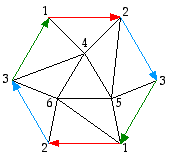
6.1.4 The third picture in Figure 6.1.10 also gives a triangulation of the real projective space. Alternatively, the following picture gives the most efficient triangulation of the real projective space. In the picture, we think of the space as obtained by identifying three pairs (red, blue, green) of the boundary edges of a 6-gon by the indicated directions.