1.3.3 Isoperimetric Inequality
We close this chapter with one of the most classical and beautiful results in differential geometry of plane curves: the Isoperimetric Inequality. It asserts that among all simple closed curves of a given length, the circle encloses the largest area.
Let \(\gamma\) be a simple closed regular curve in \(\R^2\) with length \(L\), and let \(A\) be the area of the region enclosed by \(\gamma\). Then \[L^2 \ge 4\pi A,\] with equality if and only if \(\gamma\) is a circle.
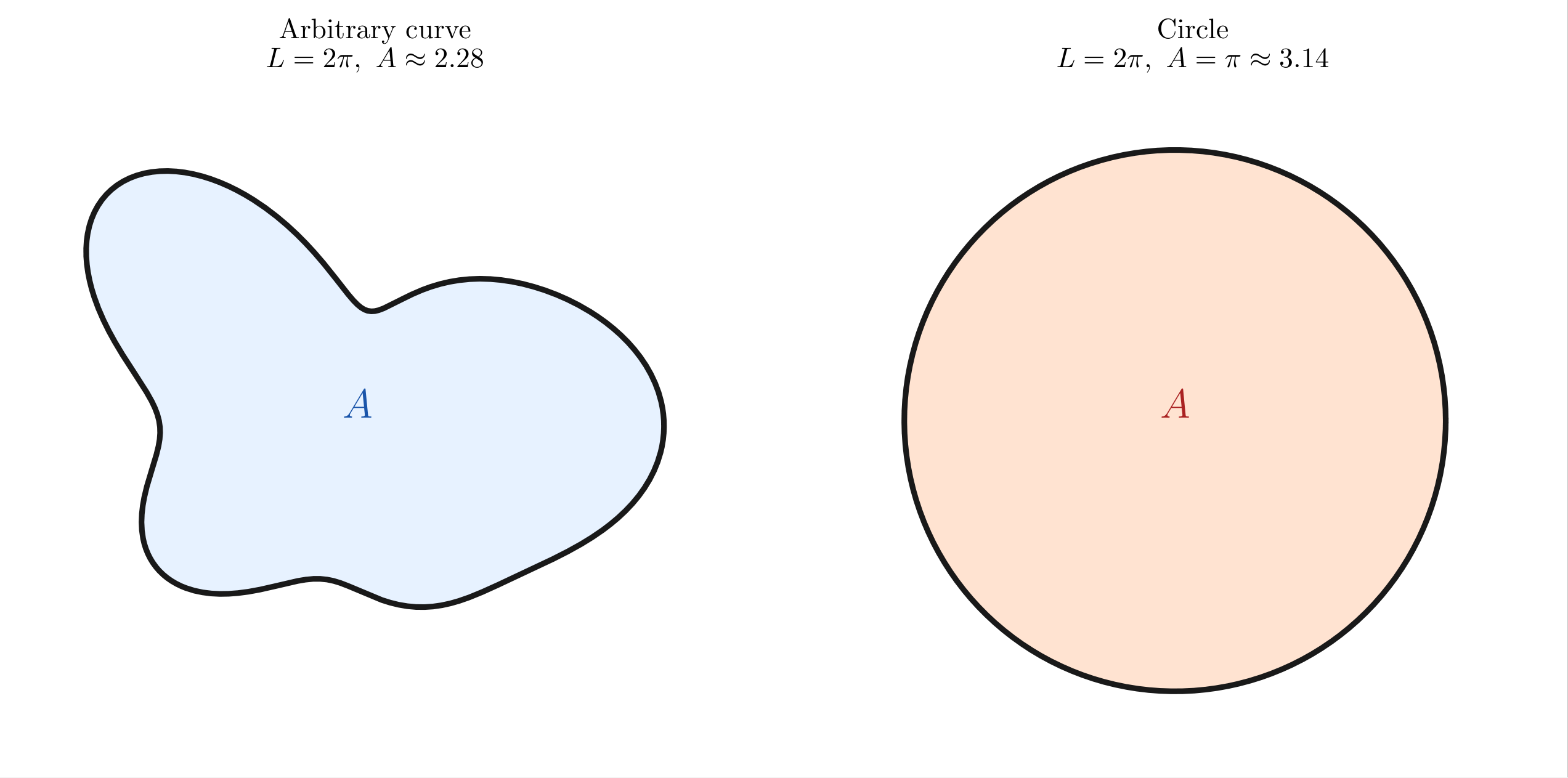
The inequality \(L^2 \ge 4\pi A\) can be equivalently stated as: among all simple closed curves of a fixed length \(L\), the enclosed area \(A\) is maximized precisely when the curve is a circle, in which case \(A = \frac{L^2}{4\pi}\). Figure 1.5 illustrates this with two curves of equal length.
Since the isoperimetric inequality is scale-invariant, we can assume without loss of generality that \(\ell = 2\pi\), then it suffices to show \(A \le \pi\). Let \(\gamma : [0, 2\pi] \to \R^2\) be an arc-length parametrization \(\gamma(s) = (x(s), y(s))\). The arc-length condition \((x'(s))^2 + (y'(s))^2 = 1\) gives: \[(1.9)\qquad \frac{1}{2\pi}\int_0^{2\pi}\bigl((x'(s))^2 + (y'(s))^2\bigr)\, ds = 1.\] Since \(\gamma\) is a closed curve, \(x(s)\) and \(y(s)\) are \(2\pi\)-periodic real-valued functions. We express them via Fourier series: \[x(s) = \sum_{n=-\infty}^{\infty} a_n e^{ins}, \quad \text{where } a_{-n} = \overline{a_n},\qquad y(s) = \sum_{n=-\infty}^{\infty} b_n e^{ins}, \quad \text{where } b_{-n} = \overline{b_n}.\] Their derivatives are: \[x'(s) = \sum_{n=-\infty}^{\infty} ina_n e^{ins}, \qquad y'(s) = \sum_{n=-\infty}^{\infty} inb_n e^{ins}.\]
Applying Parseval's identity to equation (1.9): \[(1.10)\qquad \sum_{n=-\infty}^{\infty} n^2\bigl(|a_n|^2 + |b_n|^2\bigr) = 1.\] The enclosed area \(\mathcal{A}\) is given by: \[\mathcal{A} = \frac{1}{2}\left|\int_0^{2\pi}(x(s)y'(s) - y(s)x'(s))\, ds\right|.\] Using the bilinear form of Parseval's identity: \[(1.11)\qquad \mathcal{A} = \pi\left|\sum_{n=-\infty}^{\infty} n\bigl(a_n\overline{b_n} - b_n\overline{a_n}\bigr)\right|.\]
We utilize the algebraic inequality \(|a_n\overline{b_n} - b_n\overline{a_n}| \le 2|a_n||b_n| \le |a_n|^2 + |b_n|^2\). Since \(n \in \mathbb{Z}\), we also have \(|n| \le n^2\). Establishing the chain of inequalities: \[\mathcal{A} \le \pi\sum_{n=-\infty}^{\infty}|n|\,|a_n\overline{b_n} - b_n\overline{a_n}|\] \[(1.12)\qquad \le \pi\sum_{n=-\infty}^{\infty}|n|\,(|a_n|^2 + |b_n|^2)\] \[(1.13)\qquad \le \pi\sum_{n=-\infty}^{\infty}n^2(|a_n|^2 + |b_n|^2).\] Substituting (1.10) into (1.13) yields \(\mathcal{A} \le \pi \cdot 1 = \pi\).
For \(\mathcal{A} = \pi\), equalities must hold in (1.12) and (1.13).
• Equality in (1.13) implies \(|n| = n^2\) whenever \(a_n \neq 0\) or \(b_n \neq 0\). Thus \(a_n = b_n = 0\) for all \(|n| \ge 2\).
• Equality in (1.12) implies \(2|a_n||b_n| = |a_n|^2 + |b_n|^2\), which means \(|a_n| = |b_n|\).
Using \(a_n = b_n = 0\) for \(|n| \ge 2\) and \(a_{-1} = \overline{a_1}\), \(b_{-1} = \overline{b_1}\), equation (1.10) simplifies to \(2(|a_1|^2 + |b_1|^2) = 1\). Combined with \(|a_1| = |b_1|\), we find \(|a_1| = |b_1| = \frac{1}{2}\). Let \(a_1 = \frac{1}{2}e^{i\alpha}\) and \(b_1 = \frac{1}{2}e^{i\beta}\). Equality in \(|a_1\overline{b_1} - b_1\overline{a_1}| = \frac{1}{2}\) gives \(\frac{1}{2}|\sin(\alpha-\beta)| = \frac{1}{2}\), so \(|\sin(\alpha-\beta)| = 1\), implying \(\alpha - \beta = \frac{k\pi}{2}\) for some odd integer \(k\). Expanding:
\[x(s) = a_0 + \cos(s+\alpha), \qquad y(s) = b_0 \pm \sin(s+\alpha).\]
In either case, \((x(s)-a_0)^2 + (y(s)-b_0)^2 = 1\). This is the parametric equation of a circle of radius 1 centered at \((a_0, b_0)\), completing the proof.