1.3.1 Signed Curvature
Given an arc-length parametrized curve \(\gamma(s) : I \to \R^2\), we define the tangent frame \(\mathbf{T}(s)\) as in space curves, i.e. \[\mathbf{T}(s) = \gamma'(s).\] However, instead of defining the normal frame \(\mathbf{N}(s) = \frac{1}{\kappa(s)}\mathbf{T}'(s)\), we use the frame \(J\mathbf{T}(s)\) where \(J\) is the counter-clockwise rotation by \(\frac{\pi}{2}\), i.e. \[J = \begin{bmatrix}0 & -1 \\ 1 & 0\end{bmatrix}.\] One can easily check that \(\{\mathbf{T}(s), J\mathbf{T}(s)\}\) is an orthonormal frame of \(\R^2\) for any \(s \in I\). Let's call this the TN-Frame of the curve. We will work with the TN-Frame in place of the Frenet-Serret Frame for plane curves. The reasons for doing so are twofold. For one thing, the normal frame \(J\mathbf{T}(s)\) is well-defined for any \(s \in I\) even though \(\kappa(s)\) is zero for some \(s \in I\). Hence, one can relax the non-degeneracy assumption here. For another, we can introduce the signed curvature \(k(s)\):
Given an arc-length parametrized plane curve \(\gamma(s) : I \to \R^2\), the signed curvature \(k(s) : I \to \R\) is defined as: \[k(s) := \mathbf{T}'(s) \cdot J\mathbf{T}(s).\]
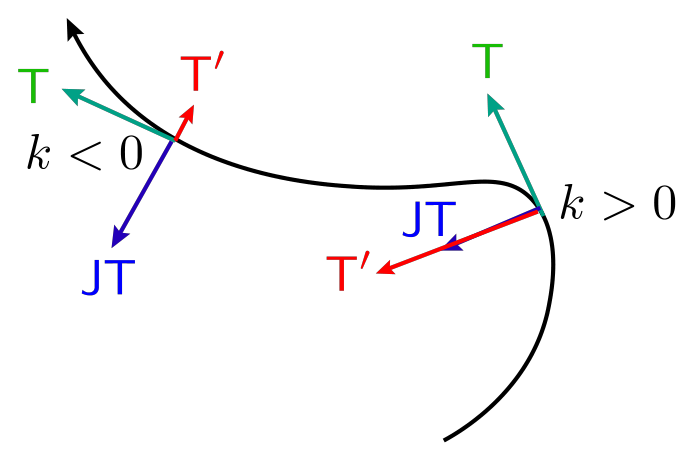
Note that \(\mathbf{T}(s)\) is unit, so by Lemma 1.7 we know \(\mathbf{T}(s)\) and \(\mathbf{T}'(s)\) are always orthogonal and hence it is either in or against the direction of \(J\mathbf{T}(s)\). Therefore, we have \[|k(s)| = |\mathbf{T}'(s)||J\mathbf{T}(s)| = |\gamma''(s)| = \kappa(s).\] The sign of \(k(s)\) is determined by whether \(\mathbf{T}'\) and \(J\mathbf{T}\) are along or against each other (see Figure 1.4).
Let's compute the signed curvature of the unit circle \[\gamma(s) = (\cos\varepsilon s,\, \sin\varepsilon s)\] where \(\varepsilon = \pm 1\). The curve is counter-clockwise oriented when \(\varepsilon = 1\), and is clockwise oriented when \(\varepsilon = -1\). Clearly it is arc-length parametrized, and \[\mathbf{T}(s) = \gamma'(s) = (-\varepsilon\sin\varepsilon s,\, \varepsilon\cos\varepsilon s)\] \[J\mathbf{T}(s) = (-\varepsilon\cos\varepsilon s,\, -\varepsilon\sin\varepsilon s)\] \[k(s) = \mathbf{T}'(s)\cdot J\mathbf{T}(s) = (-\varepsilon^2\cos\varepsilon s,\, -\varepsilon^2\sin\varepsilon s)\cdot(-\varepsilon\cos\varepsilon s,\, -\varepsilon\sin\varepsilon s) = \varepsilon^3 = \varepsilon.\]
Consider a plane curve \(\gamma(s)\) parametrized by arc-length. Let \(\theta(s)\) be the angle between the \(x\)-axis and the unit tangent vector \(\mathbf{T}(s)\). Show that: \[\mathbf{T}'(s) = \theta'(s)\,J\mathbf{T}(s) \qquad \text{and} \qquad k(s) = \theta'(s).\]
Consider a plane curve \(\gamma(s)\) parametrized by arc-length. Suppose \(|\gamma(s)|\) is maximum at \(s = s_0\). Show that: \[|k(s_0)| \ge \frac{1}{|\gamma(s_0)|}.\]
Given a regular plane curve \(\gamma(t) : I \to \R^2\), not necessarily arc-length parametrized. Denote the components of the curve by \(\gamma(t) = (x_1(t), x_2(t))\).
- Show that its signed curvature (as a function of \(t\)) is given by: \[k(t) = \frac{\gamma''(t)\cdot J\gamma'(t)}{|\gamma'(t)|^3} = \frac{x_1'(t)x_2''(t) - x_2'(t)x_1''(t)}{(x_1'(t)^2 + x_2'(t)^2)^{3/2}}.\]
- Hence, show that the graph of a smooth function \(y = f(x)\), when considered as a curve parametrized by \(x\), has signed curvature given by: \[k(x) = \frac{f''(x)}{(1 + f'(x)^2)^{3/2}}.\]
The signed curvature characterizes regular plane curves, just as curvature and torsion characterize non-degenerate space curves.
Given any smooth real-valued function \(\alpha(s) : I \to \R\), there exists a regular plane curve \(\gamma(s) : I \to \R^2\) such that its signed curvature \(k(s) \equiv \alpha(s)\). Moreover, if \(\bar{\gamma}(s) : I \to \R^2\) is another regular plane curve such that its signed curvature \(\bar{k}(s) \equiv \alpha(s)\), then there exists a \(2\times 2\) orthogonal matrix \(A\) and a constant vector \(p \in \R^2\) such that \(\bar{\gamma}(s) \equiv A\gamma(s) + p\).
Prove Theorem 1.28. Although the proof is similar to that of Theorem 1.23 for non-degenerate space curves, please do not use the latter to prove the former in this exercise. Here is a hint on how to begin the proof: Consider the initial-value problem \[\hat{e}'(s) = \alpha(s)\, J\hat{e}(s), \qquad \hat{e}(0) = \hat{i}.\]
Using Theorem 1.28, show that a regular plane curve has constant signed curvature if and only if it is a straight line or a circle.
Find an explicit plane curve \(\gamma(s)\) such that the signed curvature is given by \(k(s) = \dfrac{1}{\sqrt{s}}\).