2.1.2 Tangent Planes of Regular Surfaces
The tangent plane is an important geometric object associated to a regular surface. Condition (3) of a smooth local parametrization \(\bF(u,v)\) requires that the cross-product \(\pdF{u}\times\pdF{v}\) is non-zero for any \((u,v)\) in the domain, or equivalently, both tangent vectors \(\pdF{u}\) and \(\pdF{v}\) must be non-zero vectors and they are non-parallel to each other.
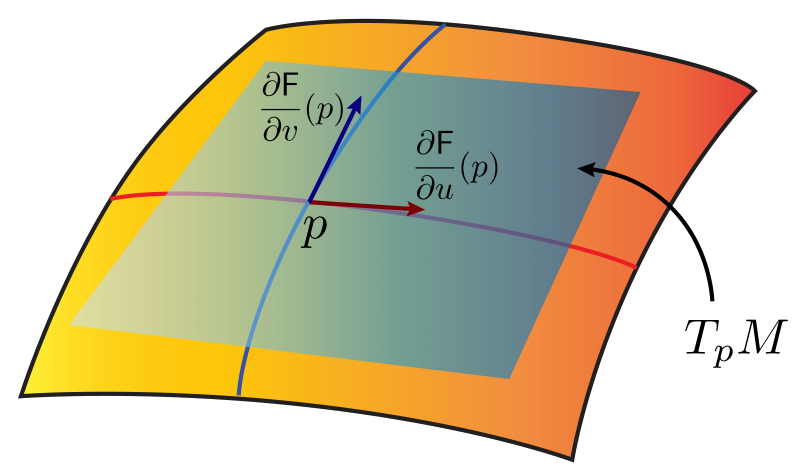
Therefore, the two vectors \(\pdF{u}\) and \(\pdF{v}\) span a two-dimensional subspace in \(\R^3\). We call this subspace the tangent plane, which is defined rigorously as follows:
Let \(M\) be a regular surface in \(\R^3\) and \(p\) be a point on \(M\). Suppose \(\bF(u,v):U\subset\R^2\to M\) is a smooth local parametrization around \(p\), then the tangent plane at \(p\), denoted by \(T_pM\), is defined as follows:
\[T_pM:=\Span\left\{\pdF{u}(p),\,\pdF{v}(p)\right\}=\left\{a\,\pdF{u}(p)+b\,\pdF{v}(p):a,b\in\R\right\}.\]
Here we have abused the notations for simplicity: \(\pdF{u}(p)\) means \(\pdF{u}\) evaluated at \((u,v)=\bF^{-1}(p)\). Similarly for \(\pdF{v}(p)\).
Rigorously, \(T_pM\) is a plane passing through the origin while \(p+T_pM\) is the plane tangent to the surface at \(p\) (see Figure 2.8). The difference between \(T_pM\) and \(p+T_pM\) is very subtle, and we will almost neglect this difference.
Show that the equation of the tangent plane \(p+T_pM\) of the graph of a smooth function \(f(x,y)\) at \(p=(x_0,y_0,f(x_0,y_0))\) is given by \[z=f(x_0,y_0)+\pd{f}{x}\Big|_{(x_0,y_0)}(x-x_0)+\pd{f}{y}\Big|_{(x_0,y_0)}(y-y_0).\]
Consider the surface \(M\) given by \(z=xf(y/x)\), where \(x\neq 0\) and \(f\) is a smooth function. Show that the tangent planes \(p+T_pM\) must pass through the origin \((0,0,0)\).
Consider the unit sphere \(x^2+y^2+z^2=1\). Determine whether each vector below is parallel to the tangent plane to the sphere at point \(p=\big(\tfrac{1}{\sqrt 3},\tfrac{1}{\sqrt 3},\tfrac{1}{\sqrt 3}\big)\). If so, express the vector as a linear combination of \(\pd{\bF}{\theta}\) and \(\pd{\bF}{\varphi}\) at \(p\) where \(\bF\) is given by \(\bF(\theta,\varphi)=(\sin\varphi\cos\theta,\sin\varphi\sin\theta,\cos\varphi)\).
- \(\mathbf{v}=(1,2,3)\)
- \(\mathbf{w}=(1,-3,2)\)