3.2.3 Curvature as the derivative of the Gauss map
Another interpretation of the second fundamental form and the shape operator is to regard it as the “derivative” (or tangent map) of the Gauss map. Recall that for an orientable hypersurface \(\Sigma^n\subset\mathbb{R}^{n+1}\), the Gauss map \(\nu\) can be regarded as a map \(\nu: \Sigma^n\to S^n\) taking a point \(p\in\Sigma^n\) to a point on the unit sphere which represents the unit normal vector at \(p\). Then, one can consider the tangent map of \(\nu\) at each point \(p\in\Sigma^n\): \[ \nu_{*p}: \Tp{p}\Sigma^n \to T_{\nu(p)}S^n. \] If \(F(u_1,\ldots,u_n)\) is a local parametrization of \(\Sigma^n\), then: \[ \nu_*\!\left(\pdF{u_i}\right) = \pd{\nu}{u_i}. \] Since \(\nu\) is unit, \(\pd{\nu}{u_i}\) is orthogonal to \(\nu\) and hence tangent to \(\Sigma^n\), so \(\pd{\nu}{u_i} = A^j_i\pdF{u_j}\). Determining the coefficients via \(\left\langle\pd{\nu}{u_i},\pdF{u_k}\right\rangle = A^j_i g_{jk}\), and using \(\left\langle\nu,\pdF{u_k}\right\rangle=0\Rightarrow\left\langle\pd{\nu}{u_i},\pdF{u_k}\right\rangle = -\left\langle\nu,\pd{^2\mathbf{F}}{u_i\partial u_k}\right\rangle = -h_{ik}\), we get \(A^l_i = g^{kl}(-h_{ik}) = -g^{kl}h_{ik}\). Therefore: \[ \nu_*\!\left(\pdF{u_i}\right) = -g^{kj}h_{ik}\pdF{u_j}. \] Recalling that the shape operator is \(S(\pdF{u_i}) = g^{jk}h_{ki}\pdF{u_j}\), we conclude that the tangent map of the Gauss map is nothing but just the negative of the shape operator!
The Gauss curvature (say for surfaces) is the determinant of \([g]^{-1}[h]\), and hence is the determinant of the shape operator, which is also the determinant of the tangent map \(\nu_*\).
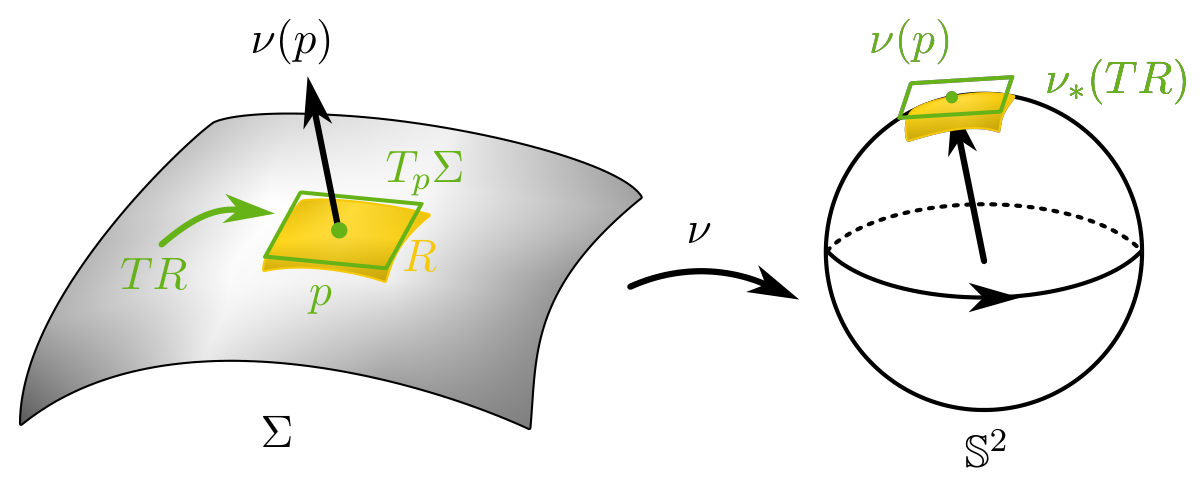
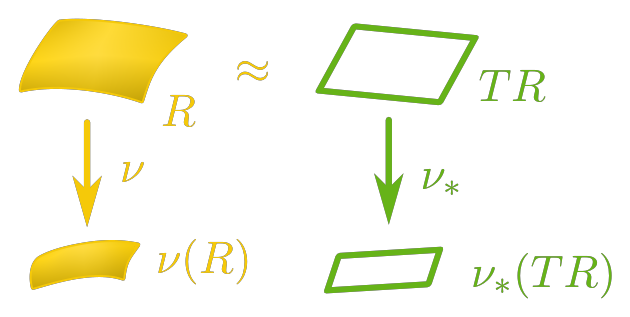
The determinant of a linear map \(T:\mathbb{R}^2\to\mathbb{R}^2\) is the area ratio between \(T(R)\) and \(R\), where \(R\) is a region in \(\mathbb{R}^2\). As such, the Gauss curvature at \(p\in\Sigma^2\), which is the determinant of the linear map \(\nu_{*p}: \Tp{p}\Sigma\to T_{\nu(p)}S^2\), is the area ratio between \(\nu_*(R)\) and \(R\), where \(R\) is a region on the tangent plane \(\Tp{p}\Sigma^2\). As the surface \(\Sigma^2\) near \(p\) can be approximated by its tangent plane, the Gauss curvature at \(p\) is then approximately the ratio between \(\nu(R)\) and \(R\) where \(R\) is a small region on \(\Sigma^2\) near \(p\).
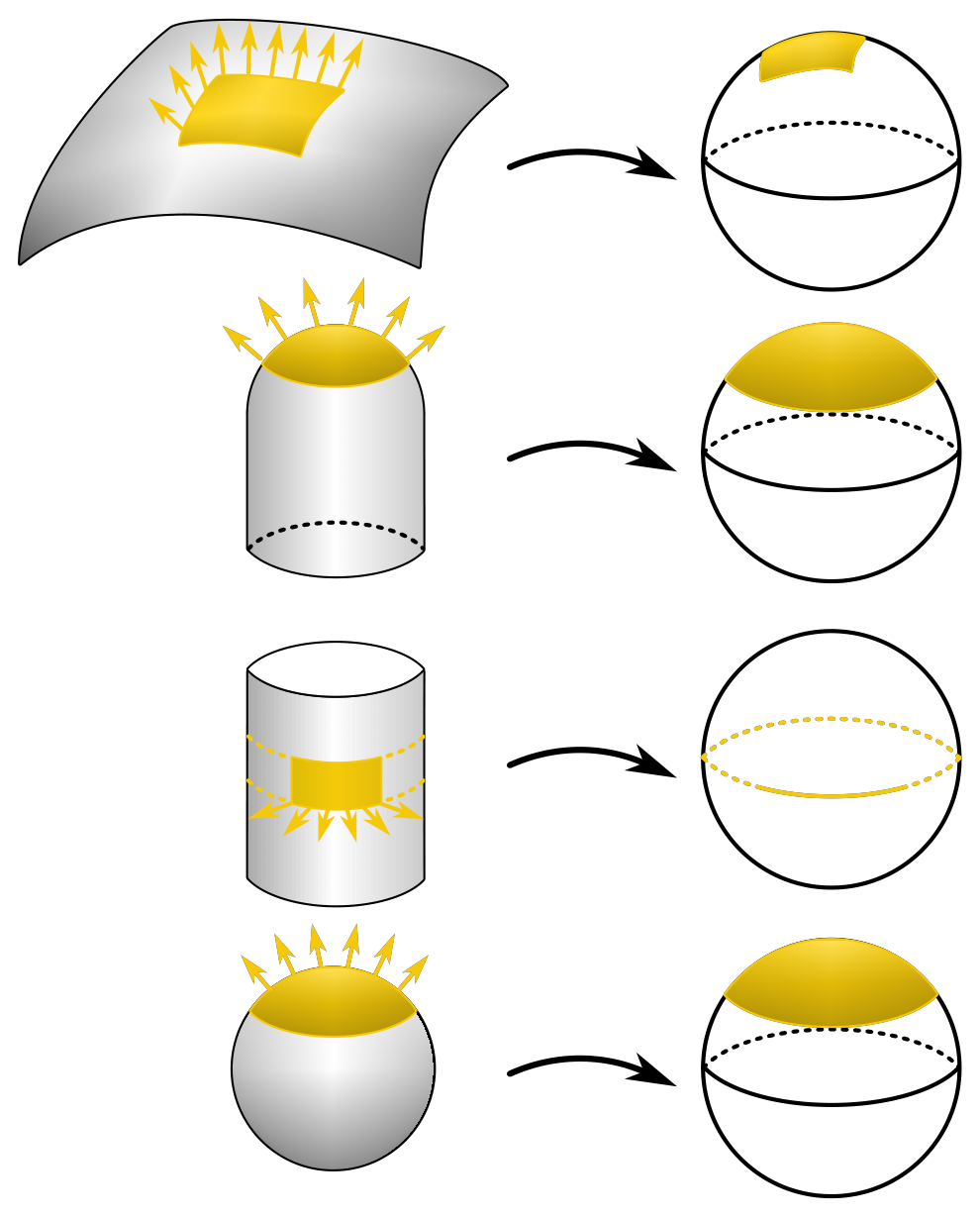
Let’s discuss the special surfaces below to get a sense of this interpretation of the Gauss curvature:
- Consider a plane in \(\mathbb{R}^3\) where its Gauss map is a constant map. Then take whatever region \(R\) on the plane, the area ratio \(\frac{\nu(R)}{R}\) is \(0\), since \(\nu(R)\) is just a point on the unit sphere. It tells us that the Gauss curvature of a plane is \(0\).
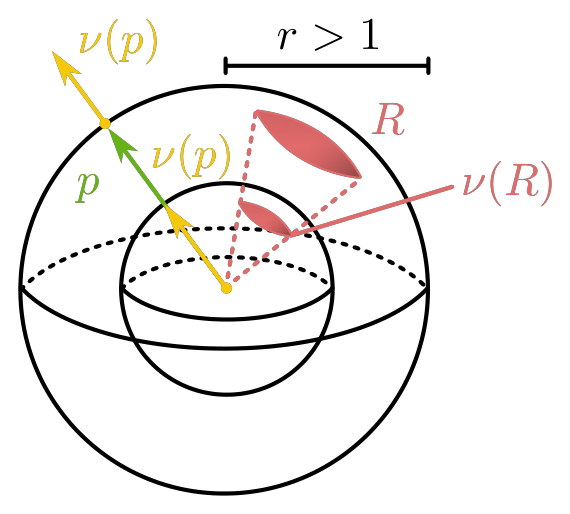
- Consider the sphere with radius \(r\). The Gauss map \(\nu: S^2(r)\to S^2(1)\) basically shrinks the region \(R\subset S^2(r)\) to a similar region \(\nu(R)\). The area ratio is the area ratio between the two spheres, i.e. \(\frac{1}{r^2}\). It reflects that the Gauss curvature of a sphere with radius \(r\) is equal to \(\frac{1}{r^2}\).
- Consider the cylinder with radius \(r\). The image of the Gauss map is a circle, hence has area \(0\). This tells us that the Gauss curvature is \(0\) too.