1.1.5 Frenet-Serret Frame
From now on, we will concentrate on regular curves only. Furthermore, we consider mostly those curves whose curvature function \(\kappa\) is nowhere vanishing. Therefore, straight-lines in \(\R^3\), or paths such as the graph of \(y = x^3\), are excluded in our discussion.
A regular curve \(\gamma(t) : I \to \R^3\) is said to be non-degenerate if its curvature satisfies \(\kappa(t) \neq 0\) for any \(t \in I\).
We now introduce an important basis of \(\R^3\) in the studies of space curves, the Frenet-Serret Frame, or the TNB-frame. It is an orthonormal basis of \(\R^3\) associated to each point of a regular curve in \(\R^3\).
Given a non-degenerate curve \(\gamma(s) : I \to \R^3\) parametrized by arc-length, we define: \[\mathbf{T}(s) := \gamma'(s) \qquad\text{(tangent)}\] \[\mathbf{N}(s) := \frac{\gamma''(s)}{|\gamma''(s)|} \qquad\text{(normal)}\] \[\mathbf{B}(s) := \mathbf{T}(s) \times \mathbf{N}(s) \qquad\text{(binormal)}\] The triple \(\{\mathbf{T}(s), \mathbf{N}(s), \mathbf{B}(s)\}\) is called the Frenet-Serret Frame of \(\R^3\) at the point \(\gamma(s)\) of the curve. See Figure 1.2.
Note that \(\mathbf{T}\) is a unit vector since \(\gamma(s)\) is arc-length parametrized. Recall that \(\kappa(s) := |\gamma''(s)|\) and the curve \(\gamma(s)\) is assumed to be non-degenerate. Therefore, \(\mathbf{N}\) is well-defined for any \(s \in I\) and is a unit vector by its definition. From Lemma 1.7, \(\mathbf{T}\) and \(\mathbf{N}\) are orthogonal to each other for any \(s \in I\). Therefore, by the definition of cross product, \(\mathbf{B}\) is also a unit vector and is orthogonal to both \(\mathbf{T}\) and \(\mathbf{N}\). To conclude, for each fixed \(s \in I\), the Frenet-Serret Frame is an orthonormal basis of \(\R^3\).
Let \(\gamma(s) = \left(\cos\frac{s}{\sqrt{2}},\, \sin\frac{s}{\sqrt{2}},\, \frac{s}{\sqrt{2}}\right)\) where \(s \in \R\). It can be verified easily that it is arc-length parametrized, i.e. \(|\gamma'(s)| = 1\) for any \(s \in \R\). The Frenet-Serret Frame of this curve is given by: \[\mathbf{T}(s) = \gamma'(s) = \left(-\frac{1}{\sqrt{2}}\sin\frac{s}{\sqrt{2}},\; \frac{1}{\sqrt{2}}\cos\frac{s}{\sqrt{2}},\; \frac{1}{\sqrt{2}}\right)\] \[\gamma''(s) = \left(-\frac{1}{2}\cos\frac{s}{\sqrt{2}},\; -\frac{1}{2}\sin\frac{s}{\sqrt{2}},\; 0\right)\] \[\mathbf{N}(s) = \frac{\gamma''(s)}{|\gamma''(s)|} = \left(-\cos\frac{s}{\sqrt{2}},\; -\sin\frac{s}{\sqrt{2}},\; 0\right)\] \[\mathbf{B}(s) = \mathbf{T}(s) \times \mathbf{N}(s) = \begin{vmatrix} \hat{i} & \hat{j} & \hat{k} \\ -\frac{1}{\sqrt{2}}\sin\frac{s}{\sqrt{2}} & \frac{1}{\sqrt{2}}\cos\frac{s}{\sqrt{2}} & \frac{1}{\sqrt{2}} \\ -\cos\frac{s}{\sqrt{2}} & -\sin\frac{s}{\sqrt{2}} & 0 \end{vmatrix} = \left(\frac{1}{\sqrt{2}}\sin\frac{s}{\sqrt{2}},\; -\frac{1}{\sqrt{2}}\cos\frac{s}{\sqrt{2}},\; \frac{1}{\sqrt{2}}\right).\]
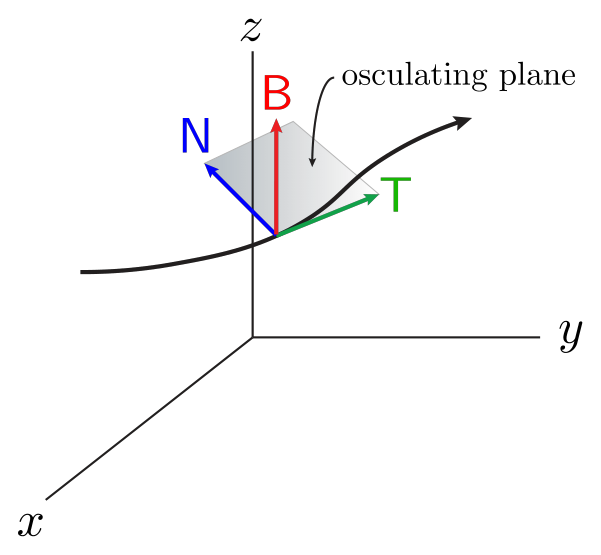
Given a non-degenerate arc-length parametrized curve \(\gamma(s) : I \to \R^3\), the osculating plane \(\Pi(s)\) of the curve is a plane in \(\R^3\) containing the point represented by \(\gamma(s)\) and parallel to both \(\mathbf{T}(s)\) and \(\mathbf{N}\), i.e. \[\Pi(s) := \gamma(s) + \Span\{\mathbf{T}(s), \mathbf{N}(s)\}.\] (See Figure 1.2)
By the definition of the Frenet-Serret Frame, the binormal vector \(\mathbf{B}(s)\) is a unit normal vector to the osculating plane \(\Pi(s)\).
Consider the curve \(\gamma(t) = (a\cos t, a\sin t, bt)\) where \(a\) and \(b\) are positive constants. First find its arc-length parametrization \(\gamma(s) := \gamma(t(s))\), and then compute its Frenet-Serret Frame.
Show that if \(\gamma(s) : I \to \R^3\) is a non-degenerate arc-length parametrized curve contained in the plane \(Ax + By + Cz = D\) where \(A, B, C\) and \(D\) are constants, then \(\mathbf{T}(s)\) and \(\mathbf{N}(s)\) are parallel to the plane \(Ax + By + Cz = 0\) for any \(s \in I\), and \(\mathbf{B}(s)\) is a constant vector which is normal to the plane \(Ax + By + Cz = 0\).
Let \(\gamma(s)\) be an arc-length parametrized curve in \(\R^3\). The normal line at \(\gamma(s)\) is the infinite straight line parallel to \(\mathbf{N}(s)\) passing through the point represented by \(\gamma(s)\). Suppose the normal line at every \(\gamma(s)\) passes through a fixed point \(p \in \R^3\). Show that \(\gamma(s)\) is a part of a circle.