1.1.6 Torsion
If the curve \(\gamma(s) : I \to \R^3\) is contained in a plane \(\Pi\) in \(\R^3\), then the osculating plane \(\Pi(s)\) coincides the plane \(\Pi\) for any \(s \in I\), and hence the binormal vector \(\mathbf{B}(s)\) is a unit normal vector to \(\Pi\) for any \(s \in I\). By continuity, \(\mathbf{B}(s)\) is a constant vector.
On the other hand, the helix considered in Example 1.14 is not planar since \(\mathbf{B}(s)\) is changing over \(s\). As \(s\) increases, the osculating plane \(\Pi(s)\) not only translates but also rotates. The magnitude of \(\frac{d\mathbf{B}}{ds}\) is therefore a measurement of how much the osculating plane rotates and how non-planar the curve \(\gamma(s)\) looks. It motivates the introduction of torsion.
However, instead of defining the torsion of a curve to be \(\left|\frac{d\mathbf{B}}{ds}\right|\), we hope to give a sign for the torsion. Before we state the definition of torsion, we first prove the following fact:
Given any non-degenerate, arc-length parametrized curve \(\gamma(s) : I \to \R^3\), the vector \(\frac{d\mathbf{B}}{ds}\) must be parallel to the normal \(\mathbf{N}(s)\) for any \(s \in I\).
First note that \(\{\mathbf{T}(s), \mathbf{N}(s), \mathbf{B}(s)\}\) is an orthonormal basis of \(\R^3\) for any \(s \in I\). Hence, we have: \[\frac{d\mathbf{B}(s)}{ds} = a(s)\mathbf{T}(s) + b(s)\mathbf{N}(s) + c(s)\mathbf{B}(s)\] where \(a(s) = \frac{d\mathbf{B}(s)}{ds}\cdot\mathbf{T}(s)\), \(b(s) = \frac{d\mathbf{B}(s)}{ds}\cdot\mathbf{N}(s)\) and \(c(s) = \frac{d\mathbf{B}(s)}{ds}\cdot\mathbf{B}(s)\). It suffices to show \(a(s) = c(s) = 0\) for any \(s \in I\).
Since \(\mathbf{B}(s)\) is unit, one can easily see that \(c(s) \equiv 0\) by considering \(\frac{d}{ds}|\mathbf{B}|^2\) (c.f. Lemma 1.7). To show \(a(s) \equiv 0\), we differentiate the identity \(\mathbf{T}(s)\cdot\mathbf{B}(s) = 0\) with respect to \(s\): \[(1.5)\qquad \frac{d\mathbf{T}}{ds}\cdot\mathbf{B} + \mathbf{T}\cdot\frac{d\mathbf{B}}{ds} = 0.\] Since \(\frac{d\mathbf{T}}{ds} = \gamma''(s) = \kappa\mathbf{N}\), we get \(\frac{d\mathbf{T}}{ds}\cdot\mathbf{B} = 0\) by the definition of \(\mathbf{B}\). Combining with (1.5), we get \(a(s) = \mathbf{T}\cdot\frac{d\mathbf{B}}{ds} = 0\). Hence \(\frac{d\mathbf{B}}{ds} = b(s)\mathbf{N}\) and it completes the proof.
Let \(\gamma(s) : I \to \R^3\) be an arc-length parametrized, non-degenerate curve. The torsion of the curve is a function \(\tau : I \to \R\) defined by: \[\tau(s) := -\frac{d\mathbf{B}}{ds}\cdot\mathbf{N}.\]
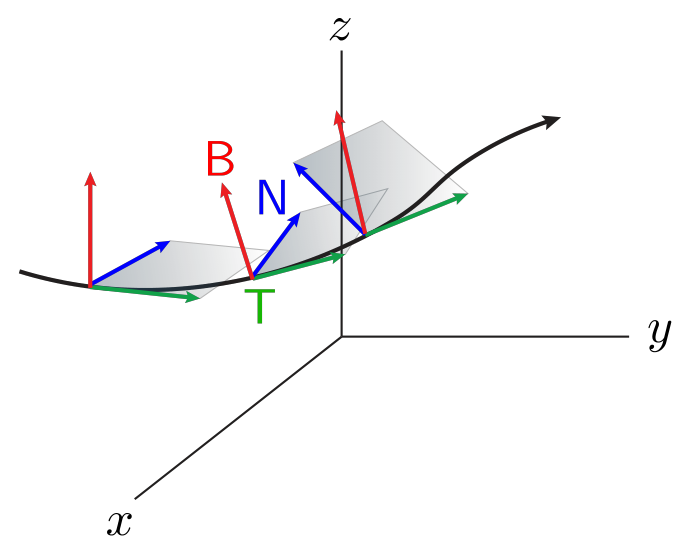
By Lemma 1.17, the vector \(\frac{d\mathbf{B}}{ds}\) and \(\mathbf{N}\) are parallel. Combining with the fact that \(\mathbf{N}\) is unit, one can see easily that: \[|\tau(s)| = \left|\frac{d\mathbf{B}}{ds}\right||\mathbf{N}|\cos 0 = \left|\frac{d\mathbf{B}}{ds}\right|.\] Therefore, the torsion can be regarded as a signed \(\left|\frac{d\mathbf{B}}{ds}\right|\) which measures the rate that the osculating plane rotates as \(s\) increases (see Figure 1.3). The negative sign appearing in the definition is merely a convention.
Consider the curve \(\gamma(s) = \left(\cos\frac{s}{\sqrt{2}},\, \sin\frac{s}{\sqrt{2}},\, \frac{s}{\sqrt{2}}\right)\) which is the helix that appeared in Example 1.14. The normal and binormal were already computed: \[\mathbf{N}(s) = \frac{\gamma''(s)}{|\gamma''(s)|} = \left(-\cos\frac{s}{\sqrt{2}},\; -\sin\frac{s}{\sqrt{2}},\; 0\right)\] \[\mathbf{B}(s) = \left(\frac{1}{\sqrt{2}}\sin\frac{s}{\sqrt{2}},\; -\frac{1}{\sqrt{2}}\cos\frac{s}{\sqrt{2}},\; \frac{1}{\sqrt{2}}\right).\] Taking the derivative, we get: \[\frac{d\mathbf{B}}{ds} = \left(\frac{1}{2}\cos\frac{s}{\sqrt{2}},\; \frac{1}{2}\sin\frac{s}{\sqrt{2}},\; 0\right).\] Therefore, the torsion of the curve is: \[\tau(s) = -\frac{d\mathbf{B}}{ds}\cdot\mathbf{N} = \frac{1}{2}.\]
Consider the curve \(\gamma(t) = (a\cos t, a\sin t, bt)\) where \(a\) and \(b\) are positive constants. Find its torsion \(\tau(s)\) as a function of the arc-length parameter \(s\).
Let \(\gamma(s) : I \to \R^3\) be a non-degenerate, arc-length parametrized curve. Prove that \(\tau(s) = 0\) for any \(s \in I\) if and only if \(\gamma(s)\) is contained in a plane. [Hint: for the “only if” part, consider the dot product \(\mathbf{B}\cdot\mathbf{T}\).]
Suppose \(\gamma(s) : I \to \R^3\) is a non-degenerate, arc-length parametrized curve such that \(\tau(s) \neq 0\) and \(\kappa'(s) \neq 0\) for any \(s \in I\). Show that the curve lies on a sphere if and only if \(\frac{1}{\kappa^2} + \left(\frac{d}{ds}\frac{1}{\kappa}\right)^2\frac{1}{\tau^2}\) is a constant.
The torsion of a non-degenerate curve \(\gamma(t)\) can be difficult to compute from the definition since it involves finding an explicit arc-length parametrization. Fortunately, just like the curvature, there is a formula for computing torsion.
Let \(\gamma(t) : I \to \R^3\) be a non-degenerate curve, then the torsion of the curve is given by: \[\tau(t) = \frac{(\gamma'(t) \times \gamma''(t))\cdot\gamma'''(t)}{|\gamma'(t) \times \gamma''(t)|^2}.\]
The purpose of this exercise is to give a proof of Proposition 1.21. As \(\gamma(t)\) is a (regular) non-degenerate curve, there exist an arc-length parametrization \(\gamma(s) := \gamma(t(s))\) and a Frenet-Serret Frame \(\{\mathbf{T}(s), \mathbf{N}(s), \mathbf{B}(s)\}\) at every point on the curve. With a little abuse of notations, we denote \(\kappa(s) := \kappa(t(s))\) and \(\tau(s) := \tau(t(s))\).
- Show that \(\tau(s) = \dfrac{(\gamma'(s) \times \gamma''(s))\cdot\gamma'''(s)}{\kappa(s)^2}\).
- Using (1.3) in the proof of Proposition 1.8, show that \(\gamma'''(t) = \left(\dfrac{ds}{dt}\right)^3 \gamma'''(s) + \mathbf{v}(s)\) where \(\mathbf{v}(s)\) is a linear combination of \(\gamma'(s)\) and \(\gamma''(s)\) for any \(s\).
- Hence, show that \((\gamma'(s) \times \gamma''(s))\cdot\gamma'''(s) = \dfrac{(\gamma'(t) \times \gamma''(t))\cdot\gamma'''(t)}{|\gamma'(t)|^6}\). [Hint: use (1.4) in the proof of Proposition 1.8.]
- Finally, complete the proof of Proposition 1.21. You may use the curvature formula proved in Proposition 1.8.
Compute the torsion \(\tau(t)\) for the ellipsoidal helix: \[\gamma(t) = (a\cos t,\, b\sin t,\, ct)\] where \(a\) and \(b\) are positive and \(c\) is non-zero.
Show that for an arc-length parametrized curve \(\gamma(s)\), the Frenet-Serret frame satisfies the following system of ODEs: \[\begin{aligned} \mathbf{T}' &= +\kappa\mathbf{N} \\ \mathbf{N}' &= -\kappa\mathbf{T} + \tau\mathbf{B} \\ \mathbf{B}' &= -\tau\mathbf{N} \end{aligned}\]