2.4.1 Tangent Maps between Regular Surfaces
Given a smooth map \(\Phi:M\to N\) between two regular surfaces \(M\) and \(N\), there is a naturally defined map called the tangent map, denoted by \(\Phi_*\) in this course, between the tangent planes \(T_pM\) and \(T_{\Phi(p)}N\).
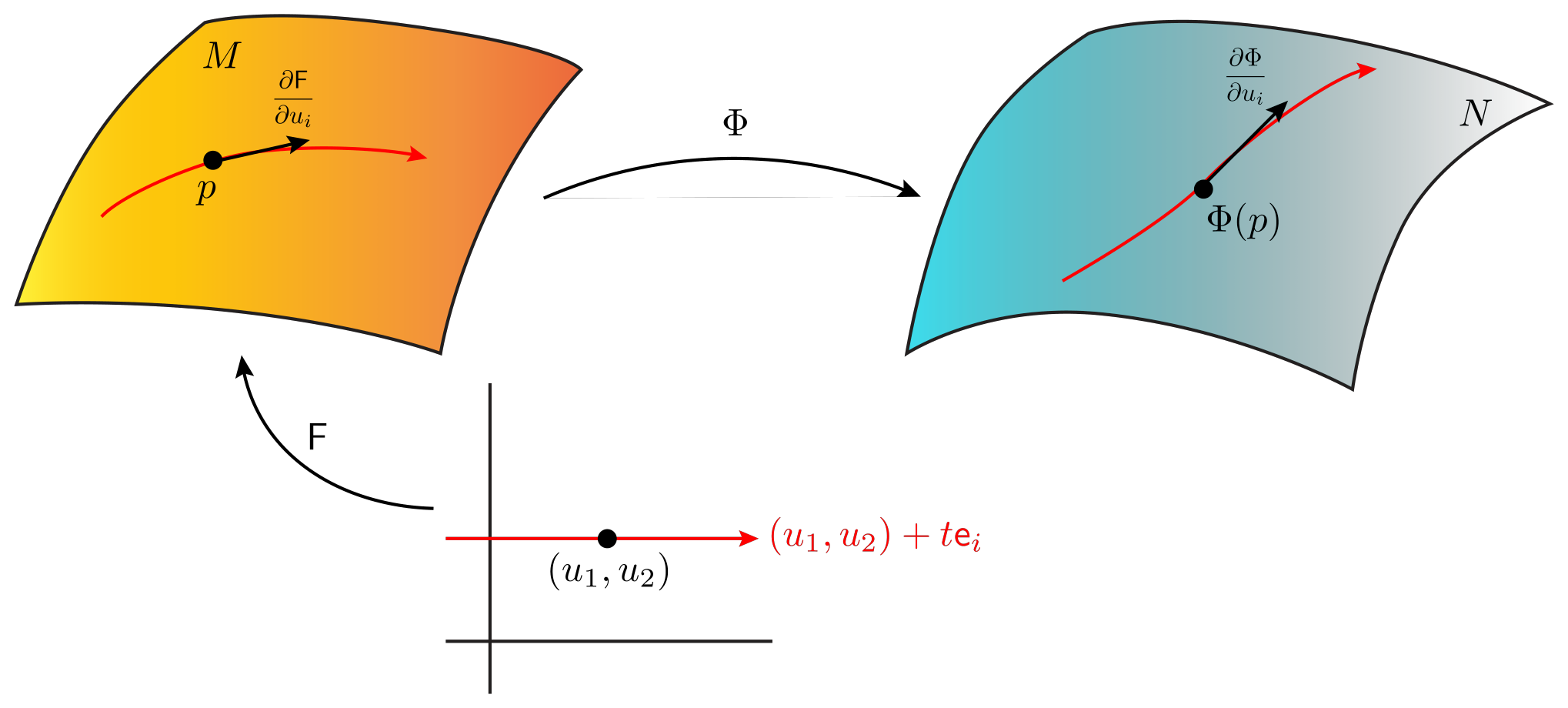
Let us consider a smooth local parametrization \(\bF(u_1,u_2):U_M\to M\). The composition \(\Phi\circ\bF\) can be regarded as a map from \(U_M\) to \(\R^3\), so one can talk about its partial derivatives \(\pd{(\Phi\circ\bF)}{u_i}\): \[\pd{\Phi}{u_i}(\Phi(p)):=\pd{(\Phi\circ\bF)}{u_i}\Big|_{(u_1,u_2)}=\frac{d}{dt}\Big|_{t=0}\Phi\circ\bF\big((u_1,u_2)+t\,\hat{\mathbf{e}}_i\big)\] where \((u_1,u_2)\) is a point in \(U_M\) such that \(\bF(u_1,u_2)=p\). The curve \(\bF((u_1,u_2)+t\,\hat{\mathbf{e}}_i)\) is a curve on \(M\) with parameter \(t\) along the \(u_i\)-direction. The curve \(\Phi\circ\bF((u_1,u_2)+t\,\hat{\mathbf{e}}_i)\) is then the image of the \(u_i\)-curve of \(M\) under the map \(\Phi\) (see Figure 2.11). It is a curve on \(N\), so \(\pd{\Phi}{u_i}\) is a tangent vector to the surface \(N\).
Denote \(S^2\) to be the unit sphere \(x^2+y^2+z^2=1\). Let \(\Phi:S^2\to S^2\) be the rotation map about the \(z\)-axis defined by \(\Phi(x,y,z)=(x\cos\alpha-y\sin\alpha,\ x\sin\alpha+y\cos\alpha,\ z)\) where \(\alpha\) is a fixed angle. Calculate the following partial derivatives under the given local parametrizations:
- \(\pd{\Phi}{\theta}\) and \(\pd{\Phi}{\varphi}\) under \(\bF(\theta,\varphi)=(\sin\varphi\cos\theta,\sin\varphi\sin\theta,\cos\varphi)\);
- \(\pd{\Phi}{u}\) and \(\pd{\Phi}{v}\) under \(\bF_2\) in Example 2.4;
- \(\pd{\Phi}{u}\) and \(\pd{\Phi}{v}\) under \(\bF_+\) in Example 2.5.
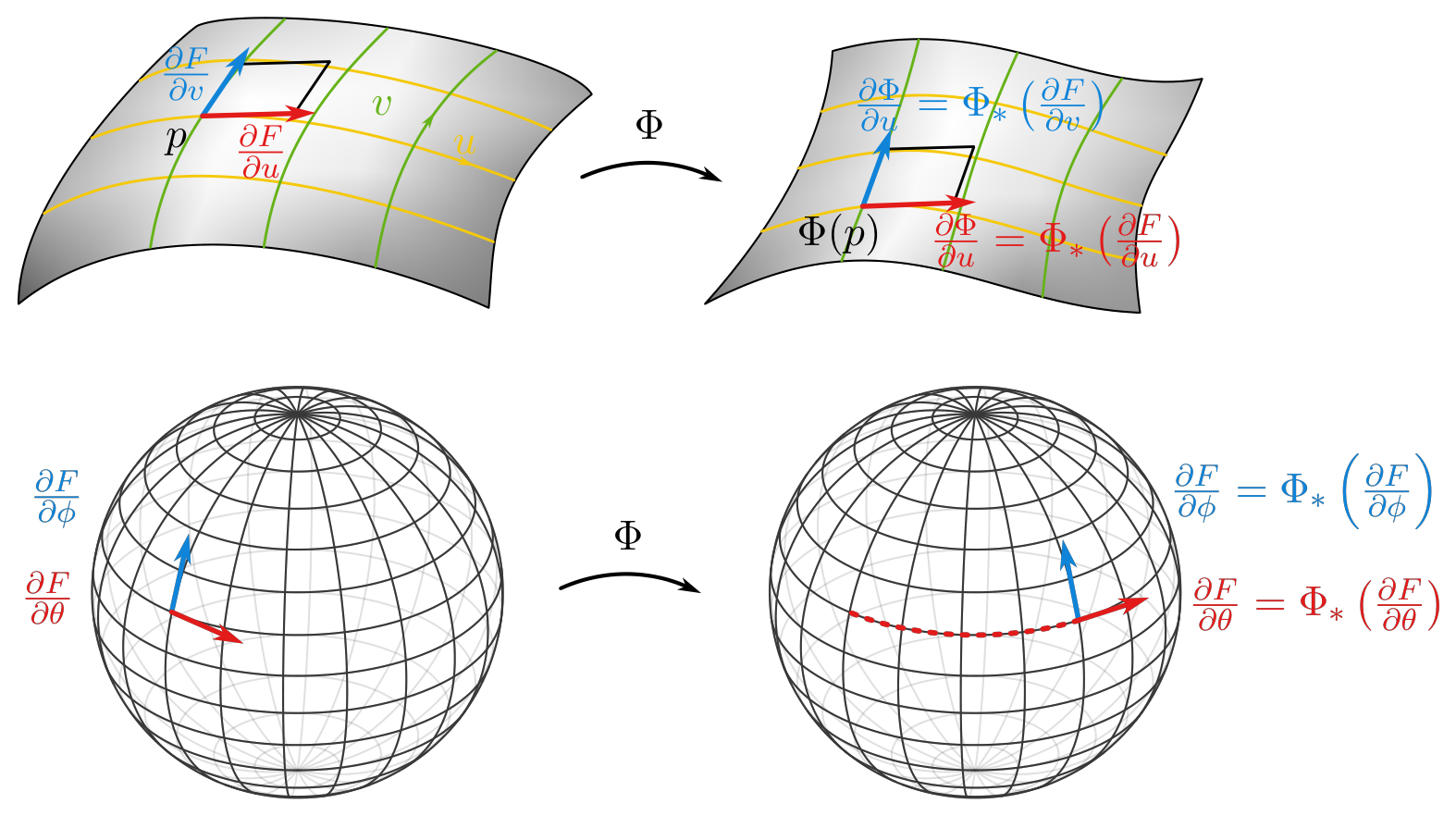
Next, we write the partial derivative \(\pd{\Phi}{u_i}\) in a fancy way. Define \(\Phi_*\big(\pdF{u_i}\big):=\pd{\Phi}{u_i}.\) Then, one can regard \(\Phi_*\) as a map that takes the tangent vector \(\pdF{u_i}\) in \(T_pM\) to another vector \(\pd{\Phi}{u_i}\) in \(T_{\Phi(p)}N\). Since \(\big\{\pdF{u_i}(p)\big\}\) is a basis of \(T_pM\), one can then extend \(\Phi_*\) linearly and define it as the tangent map of \(\Phi\). Precisely, we have:
Let \(\Phi:M\to N\) be a smooth map between two regular surfaces \(M\) and \(N\) in \(\R^3\). Let \(\bF:U_M\to M\) and \(\bG:U_N\to N\) be two smooth local parametrizations covering \(p\) and \(\Phi(p)\) respectively. Then, the tangent map of \(\Phi\) at \(p\in M\) is denoted by \((\Phi_*)_p\) and is defined as: \[(\Phi_*)_p:T_pM\to T_{\Phi(p)}N,\qquad(\Phi_*)_p\left(\sum_{i=1}^{2}a_i\,\pdF{u_i}(p)\right)=\sum_{i=1}^{2}a_i\,\pd{\Phi}{u_i}(\Phi(p)).\] If the point \(p\) is clear from the context, \((\Phi_*)_p\) can be simply denoted by \(\Phi_*\).
Some textbooks may use \(d\Phi_p\) to denote the tangent map of \(\Phi\) at \(p\). \(\square\)
Consider the unit sphere \(S^2\) locally parametrized by \(\bF(\theta,\varphi)=(\sin\varphi\cos\theta,\sin\varphi\sin\theta,\cos\varphi)\) and the rotation map \(\Phi(x,y,z)=(x\cos\alpha-y\sin\alpha,x\sin\alpha+y\cos\alpha,z)\). From Exercise 2.26, one should have figured out that \[\begin{aligned}\pd{\Phi}{\theta}&=(-\sin\varphi\sin(\theta+\alpha),\ \sin\varphi\cos(\theta+\alpha),\ 0),\\[4pt]\pd{\Phi}{\varphi}&=(\cos\varphi\cos(\theta+\alpha),\ \cos\varphi\sin(\theta+\alpha),\ -\sin\varphi).\end{aligned}\]
Next we want to write them in terms of the basis \(\big\{\pd{\bF}{\theta},\pd{\bF}{\varphi}\big\}\). However, we should be careful about the base points of these vectors. Consider a point \(p\in S^2\) with local coordinates \((\theta,\varphi)\); the vectors \(\pd{\Phi}{\theta}\) and \(\pd{\Phi}{\varphi}\) computed above are based at the point \(\Phi(p)\) with local coordinates \((\theta+\alpha,\varphi)\). Therefore, we should express them in terms of the basis \(\big\{\pd{\bF}{\theta}(\Phi(p)),\pd{\bF}{\varphi}(\Phi(p))\big\}\), not \(\big\{\pd{\bF}{\theta}(p),\pd{\bF}{\varphi}(p)\big\}\). At \(\Phi(p)\), we have \[\pd{\bF}{\theta}(\Phi(p))=(-\sin\varphi\sin(\theta+\alpha),\sin\varphi\cos(\theta+\alpha),0)=\pd{\Phi}{\theta}(\Phi(p)),\] \[\pd{\bF}{\varphi}(\Phi(p))=(\cos\varphi\cos(\theta+\alpha),\cos\varphi\sin(\theta+\alpha),-\sin\varphi)=\pd{\Phi}{\varphi}(\Phi(p)).\]
Therefore, the tangent map \((\Phi_*)_p\) acts on the basis vectors by \((\Phi_*)_p\big(\pd{\bF}{\theta}(p)\big)=\pd{\bF}{\theta}(\Phi(p))\) and \((\Phi_*)_p\big(\pd{\bF}{\varphi}(p)\big)=\pd{\bF}{\varphi}(\Phi(p))\). In other words, the matrix representation \([(\Phi_*)_p]\) with respect to the bases \(\big\{\pd{\bF}{\theta}(p),\pd{\bF}{\varphi}(p)\big\}\) for \(T_pS^2\) and \(\big\{\pd{\bF}{\theta}(\Phi(p)),\pd{\bF}{\varphi}(\Phi(p))\big\}\) for \(T_{\Phi(p)}S^2\) is the identity matrix. However, it is not perfectly correct to say \((\Phi_*)_p\) is an identity map, since the domain and co-domain are different tangent planes. \(\square\)
Let \(\Phi\) be as in Example 2.26. Consider the stereographic parametrization \(\bF_+(u,v)\) defined in Example 2.5. Suppose \(p\in S^2\), express the matrix representation \([(\Phi_*)_p]\) with respect to the bases \(\big\{\pd{\bF_+}{u},\pd{\bF_+}{v}\big\}_p\) and \(\big\{\pd{\bF_+}{u},\pd{\bF_+}{v}\big\}_{\Phi(p)}\).