Overview
Let \(M\) be a regular surface in \(\R^3\) with a smooth local parametrization \(\bF(u_1,u_2):U\to M\). Then, for any \(p\in\bF(U)\), one can define the partial derivatives for a function \(f:M\to\R\) at \(p\) as follows. The subtle issue is that the domain of \(f\) is the surface \(M\), but by pre-composing \(f\) with \(\bF\), i.e. \(f\circ\bF\), one can regard it as a map from \(U\subset\R^2\) to \(\R\). With a little abuse of notations, we denote \[\pd{f}{u_j}(p):=\pd{(f\circ\bF)}{u_j}(u_1,u_2)\] where \((u_1,u_2)\) is the point corresponding to \(p\), i.e. \(\bF(u_1,u_2)=p\).
Note that \(\pd{f}{u_j}(p)\) is defined locally on \(\bF(U)\), and depends on the choice of local parametrization \(\bF\) near \(p\). \(\square\)
Let \(M\) be a regular surface in \(\R^3\), and \(f:M\to\R\) be a function defined on \(M\). We say \(f\) is \(C^k\) at \(p\in M\) if for any smooth local parametrization \(\bF:U\to M\) with \(p\in\bF(U)\), the composition \(f\circ\bF\) is \(C^k\) at \((u_1,u_2)\) corresponding to \(p\).
If \(f\) is \(C^k\) at \(p\) for any \(p\in M\), then we say that \(f\) is a \(C^k\) function on \(M\). Here \(k\) can be taken to be \(\infty\), and in such case we call \(f\) to be a \(C^\infty\) (or smooth) function.
Although we require \(f\circ\bF\) to be \(C^k\) at \(p\in M\) for any local parametrization \(\bF\) in order to say that \(f\) is \(C^k\), by Proposition 2.12 it suffices to show that \(f\circ\bF\) is \(C^k\) at \(p\) for at least one \(\bF\) near \(p\). It is because \[f\circ\widetilde{\bF}=(f\circ\bF)\circ(\bF^{-1}\circ\widetilde{\bF})\] and compositions of \(C^k\) maps (between Euclidean spaces) are \(C^k\). \(\square\)
Let \(M\) be a regular surface in \(\R^3\), then each of the \(x,y\) and \(z\) coordinates in \(\R^3\) can be regarded as a function from \(M\) to \(\R\). For any smooth local parametrization \(\bF:U\to M\) around \(p\) given by \(\bF(u_1,u_2)=(x(u_1,u_2),y(u_1,u_2),z(u_1,u_2))\), we have \(x\circ\bF(u_1,u_2)=x(u_1,u_2)\). Since \(\bF\) is \(C^\infty\), we get \(x\circ\bF\) is \(C^\infty\) as well. Therefore, the coordinate functions \(x,y\) and \(z\) for any regular surface is smooth. \(\square\)
Let \(f:M\to\R\) be the function from a regular surface \(M\) in \(\R^3\) defined by \(f(p):=|p-p_0|^2\) where \(p_0=(x_0,y_0,z_0)\) is a fixed point of \(\R^3\). Suppose \(\bF(u,v)\) is a local parametrization of \(M\). We want to compute \(\pd{f}{u}\) and \(\pd{f}{v}\).
Write \((x,y,z)=\bF(u,v)\) so that \(x,y\) and \(z\) are functions of \((u,v)\). Then \[\begin{aligned}\pd{f}{u}&:=\pd{}{u}(f\circ\bF)=\pd{}{u}\big((x-x_0)^2+(y-y_0)^2+(z-z_0)^2\big)\\[4pt]&=2(x-x_0)\pd{x}{u}+2(y-y_0)\pd{y}{u}+2(z-z_0)\pd{z}{u}.\end{aligned}\]
Note that we can differentiate \(x,y\) and \(z\) by \(u\) because \(\bF(u,v)\) is smooth. Similarly, we have \[\pd{f}{v}=2(x-x_0)\pd{x}{v}+2(y-y_0)\pd{y}{v}+2(z-z_0)\pd{z}{v}.\] Again since \(\bF(u,v)\) (and hence \(x,y\) and \(z\)) is a smooth function of \((u,v)\), we can differentiate \(\pd{f}{u}\) and \(\pd{f}{v}\) as many times as we wish. This concludes that \(f\) is a smooth function. \(\square\)
Let \(p_0(x_0,y_0,z_0)\) be a point in \(\R^3\) and let \(f(p)=|p-p_0|\) be the Euclidean distance between \(p\) and \(p_0\) in \(\R^3\). Suppose \(M\) is a regular surface in \(\R^3\), one can then restrict the domain of \(f\) to \(M\) and consider it as a function \(f:M\to\R,\ p\mapsto|p-p_0|\). Under what condition is the function \(f:M\to\R\) smooth?
Now let \(M\) and \(N\) be two regular surfaces in \(\R^3\). Then, one can also talk about mappings \(\Phi:M\to N\) between them. In this section, we will define the notion of smooth maps between two surfaces.
Suppose \(\bF:U_M\to M\) and \(\bG:U_N\to N\) are two smooth local parametrizations of \(M\) and \(N\) respectively. One can then consider the composition \(\bG^{-1}\circ\Phi\circ\bF\) after shrinking the domain. It is then a map between open subsets of \(\R^2\).
However, in order for this composition to be well-defined, we require the image of \(\Phi\circ\bF\) to be contained in the image of \(\bG\), which is not always guaranteed. Let \(W:=\Phi(O_M)\cap O_N\) be the overlapping region on \(N\) of these two images. Then, provided that \(W\neq\varnothing\), the composition \(\bG^{-1}\circ\Phi\circ\bF\) becomes well-defined as a map on \[\bG^{-1}\circ\Phi\circ\bF:(\Phi\circ\bF)^{-1}(W)\to U_N.\] From now on, whenever we talk about this composition \(\bG^{-1}\circ\Phi\circ\bF\), we always implicitly assume that \(W\neq\varnothing\) and its domain is \((\Phi\circ\bF)^{-1}(W)\).
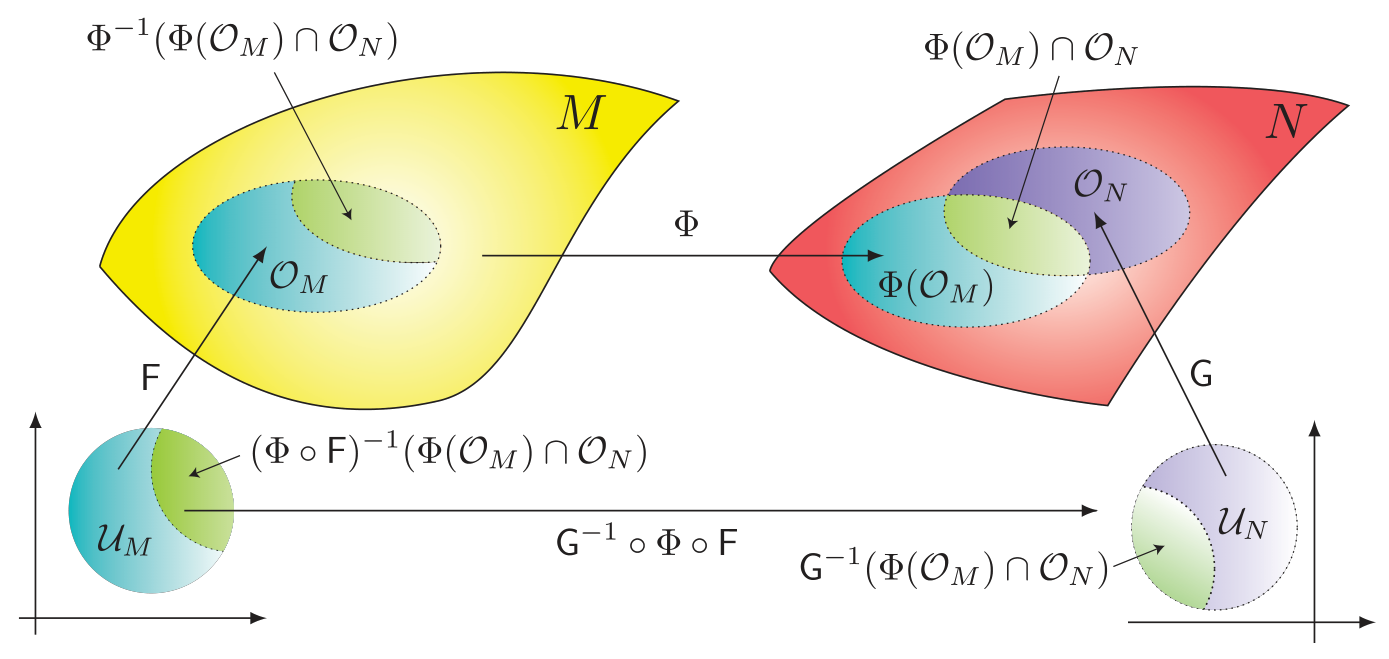
Let \(M\) and \(N\) be two regular surfaces in \(\R^3\), and \(\Phi:M\to N\) be a map between them. We say \(\Phi\) is \(C^k\) at \(p\in M\) if for any smooth local parametrization \(\bF:U_M\to M\) with \(p\in\bF(U_M)\), and \(\bG:U_N\to N\) with \(\Phi(p)\in\bG(U_N)\), the composition \(\bG^{-1}\circ\Phi\circ\bF\) is \(C^k\) at \(\bF^{-1}(p)\) as a map between subsets of \(\R^2\).
If \(\Phi\) is \(C^k\) at \(p\) for any \(p\in M\), then we say that \(\Phi\) is \(C^k\) on \(M\). Here \(k\) can be taken to be \(\infty\), and in such case we call \(\Phi\) to be \(C^\infty\) (or smooth) on \(M\).
Although we require \(\bG^{-1}\circ\Phi\circ\bF\) to be \(C^k\) at \(p\in M\) for any local parametrizations \(\bF\) and \(\bG\) in order to say that \(\Phi\) is \(C^k\), by Proposition 2.12 it suffices to show that \(\bG^{-1}\circ\Phi\circ\bF\) is \(C^k\) at \(p\) for at least one pair of \(\bF\) and \(\bG\). It is because \[\widetilde{\bG}^{-1}\circ\Phi\circ\widetilde{\bF}=(\widetilde{\bG}^{-1}\circ\bG)\circ(\bG^{-1}\circ\Phi\circ\bF)\circ(\bF^{-1}\circ\widetilde{\bF})\] and compositions of \(C^k\) maps (between Euclidean spaces) are \(C^k\). \(\square\)
Let \(S^2\) be the unit sphere in \(\R^3\). Consider the antipodal map \(\Phi:S^2\to S^2\) taking \(P\) to \(-P\). In Example 2.4, two of the local parametrizations are given by \(\bF_1(u_1,u_2)=(u_1,u_2,\sqrt{1-u_1^2-u_2^2}):B_1(0)\to S^2_+\) and \(\bF_2(v_1,v_2)=(v_1,v_2,-\sqrt{1-v_1^2-v_2^2}):B_1(0)\to S^2_-\), where \(B_1(0)\) is the open unit disk in \(\R^2\) centered at the origin. One can compute that \[\begin{aligned}\bF_2^{-1}\circ\Phi\circ\bF_1(u_1,u_2)&=\bF_2^{-1}\circ\Phi\big(u_1,u_2,\sqrt{1-u_1^2-u_2^2}\big)\\[4pt]&=\bF_2^{-1}\big(-u_1,-u_2,-\sqrt{1-u_1^2-u_2^2}\big)=(-u_1,-u_2).\end{aligned}\]
Clearly, the map \((u_1,u_2)\mapsto(-u_1,-u_2)\) is \(C^\infty\). It shows the antipodal map \(\Phi\) is \(C^\infty\) at every point in \(\bF_1(B_1(0))\). One can show in a similar way using other local parametrizations that \(\Phi\) is \(C^\infty\) at points on \(S^2\) not covered by \(\bF_1\).
Note that, for instance, the images of \(\Phi\circ\bF_1\) and \(\bF_1\) are disjoint, and so \(\bF_1^{-1}\circ\Phi\circ\bF_1\) is not well-defined. We don’t need to verify whether it is smooth. \(\square\)
Let \(\Phi\) be the antipodal map considered in Example 2.20, and \(\bF_+\) and \(\bF_-\) be the two stereographic parametrizations of \(S^2\) defined in Example 2.5. Compute the maps \(\bF_+^{-1}\circ\Phi\circ\bF_+\), \(\bF_-^{-1}\circ\Phi\circ\bF_+\), \(\bF_+^{-1}\circ\Phi\circ\bF_-\) and \(\bF_-^{-1}\circ\Phi\circ\bF_-\). State their domains, and verify that they are smooth on their domains.
Denote \(S^2\) to be the unit sphere \(x^2+y^2+z^2=1\). Let \(\Phi:S^2\to S^2\) be the rotation map about the \(z\)-axis defined by \(\Phi(x,y,z)=(x\cos\alpha-y\sin\alpha,\ x\sin\alpha+y\cos\alpha,\ z)\) where \(\alpha\) is a fixed angle. Show that \(\Phi\) is smooth.
Let \(M\) and \(N\) be two regular surfaces. If a map \(\Phi:M\to N\) is \(C^\infty\), invertible, with \(C^\infty\) inverse map \(\Phi^{-1}:N\to M\), then we say:
A map \(\Phi:M\to N\) between two regular surfaces \(M\) and \(N\) in \(\R^3\) is said to be a diffeomorphism if \(\Phi\) is \(C^\infty\) and invertible, and also the inverse map \(\Phi^{-1}\) is \(C^\infty\). If such a map \(\Phi\) exists between \(M\) and \(N\), then we say the surfaces \(M\) and \(N\) are diffeomorphic.
The antipodal map \(\Phi:S^2\to S^2\) described in Example 2.20 is a diffeomorphism between \(S^2\) and itself. \(\square\)
The sphere \(x^2+y^2+z^2=1\) and the ellipsoid \(\dfrac{x^2}{a^2}+\dfrac{y^2}{b^2}+\dfrac{z^2}{c^2}=1\) are diffeomorphic, under the map \(\Phi(x,y,z)=(ax,by,cz)\) restricted on \(S^2\). \(\square\)
Given any pair of \(C^\infty\) functions \(f,g:\R^2\to\R\), show that the graphs \(\Gamma_f\) and \(\Gamma_g\) are diffeomorphic.
Show that \(\Phi:S^2\to S^2\) defined in Exercise 2.23 is a diffeomorphism.